
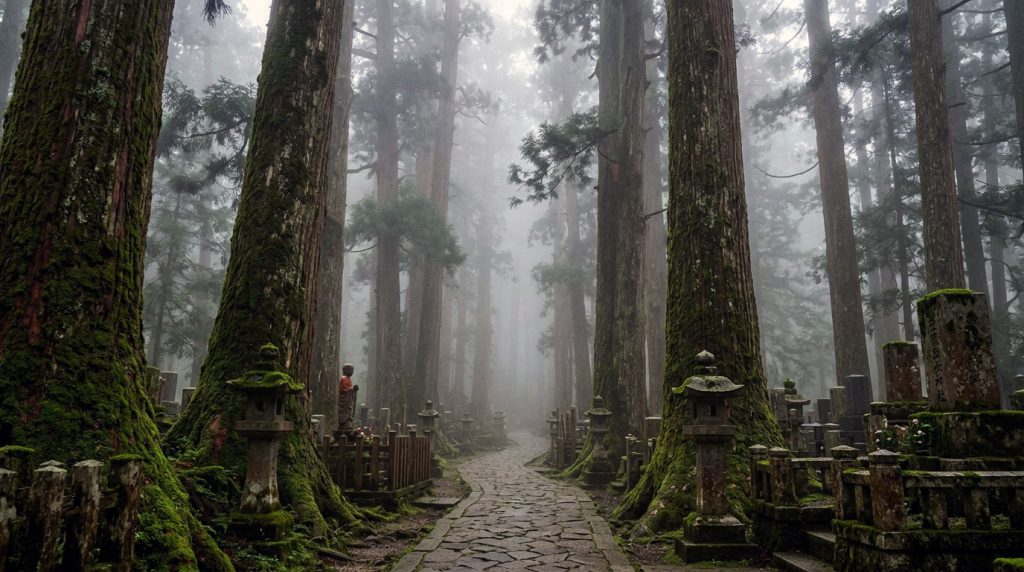
I remember standing early one morning among the towering, moss-draped cedars of Mount Kōya, and feeling something in the air before I could even name it. It wasn’t just the dampness or the cold. It was a quiet, heavy stillness — a presence hanging between the ancient tombstones and the filtered canopy above, something that made me feel small in a good way, like I’d walked into a layer of history that was already there long before I showed up.
Travelers often reach for modern slang to describe a feeling like this — “vibe,” “energy.” But Japanese culture mapped this exact invisible world thousands of years ago, in a single character: Ki 気.
To understand Ki is to unlock a new lens for experiencing Japan — one that turns you from a passive person staring at scenery into someone actively relating to the landscape around you.
The Breath of the Cosmos Meets the Grain of the Earth
In modern Japanese, you’ll see Ki written simply as 気. But look closely at old shrine banners or martial arts scrolls, and you’ll find its original form: 氣. For Shirakawa Shizuka, the original character reveals two distinct, natural forces coming together:
[ 气 ] Celestial Breath / Vapor (The Unseen Atmosphere)
+
[ 米 ] Rice / Physical Grain (The Earthly Anchor)
=
[ 氣 ] KI: Life Energy Born at the Intersection
Most Western ideas of “energy” picture raw force — sunlight, lightning, fire. The ancient Sino-Japanese worldview framed it differently: as a relationship. Ki is what happens when the ethereal, celestial mist 气 descends and anchors itself inside physical nourishment 米. You don’t possess energy. It creates itself in the gap between the sky and the earth.
Grounding the Air: From High Temples to Simple Meals
This cosmic dynamic isn’t in any textbooks. It plays out in ordinary moments, every day, if you slow down enough to notice it. Take the simple act of eating. Buddhist tradition teaches that when you slow your internal engine down, you stop treating food as fuel and start experiencing its actual ki. I think about this every time I have salt-grilled mackerel — saba — cooked slow over charcoal with barely any seasoning.
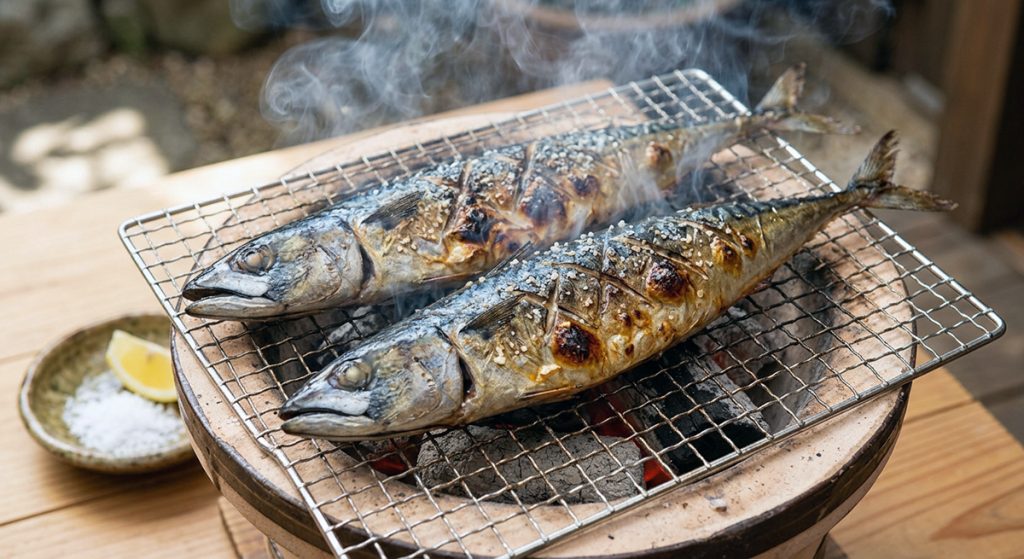
Honestly, it’s one of the only foods I’d happily eat every single day for the rest of my life. The fat, the crisp skin, the depth of it — eaten with attention, a meal like that stops being routine and becomes something that grounds you, reconnecting your body to the moment you’re actually in.
The Cost of Over-Optimization
When Japan modernized its writing system after World War II, scholars simplified the traditional 氣 into 気, swapping the rice radical 米 for a quicker two-stroke mark, メ, to make the character faster to write.
It was a practical choice for a faster-moving world. But just like you and me, when we rush to optimize, we tend to leave things behind. Just as writing a character in two strokes instead of six strips away part of its story, rushing through a temple, eating a meal on the move, or checking sights off a list can strip away the experience itself. Doesn’t it?
The old character 氣 is a reminder that the richest moments need time to actually digest. They ask you to slow down enough for the invisible mist to meet the solid earth.
A Shift in Perception for Your Journey
Next time you’re sitting in a café in Tokyo, or watching the Shiga countryside slide past a train window, try something small: don’t just look at the landscape like it’s a picture frame. Notice the threads connecting you to it. Whether it’s an old pine tree, locals bowing at a shrine gate, or a wooden ema plate swinging slightly in the wind, remember — everything in front of you is a relationship, waiting to be felt rather than photographed.
You don’t need to go looking for “spiritual energy.” It’s already hanging in the morning mist, resting in a bowl of warm rice, and sitting quietly in the space between your own breath and the world around you. When do you slow down to notice it?
If this is the kind of thing that pulls at you, the Kanji Printing Workshop builds around exactly this idea — choosing a character that means something to you, and slow down long enough to actually understand why.
Leave a Reply