
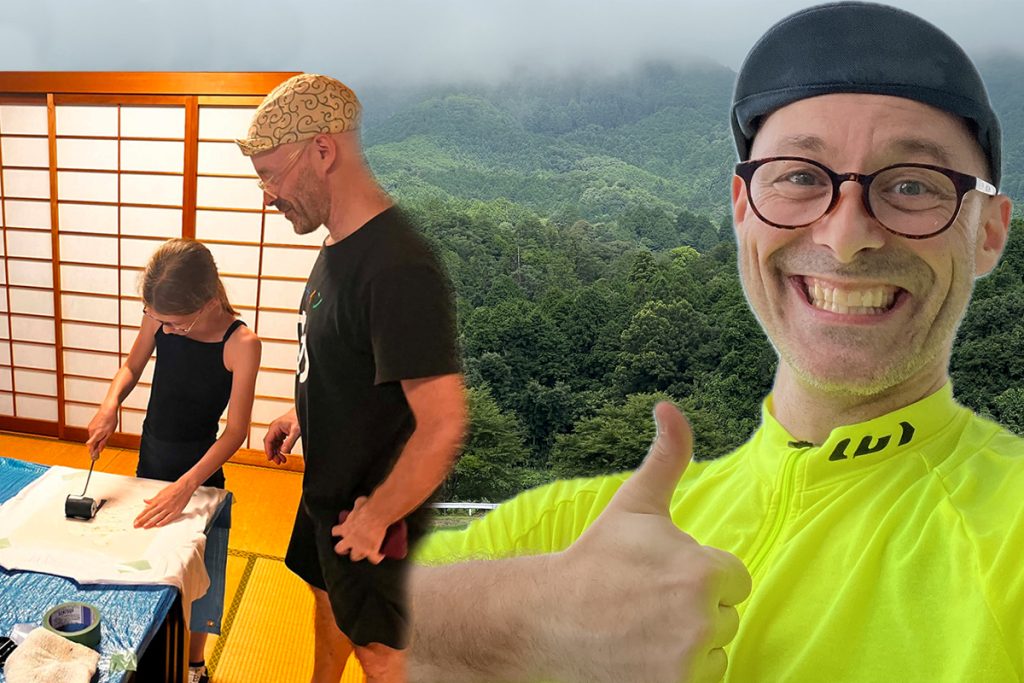
The Idea Hiding Inside the Object
For as long as I can remember, I’ve been drawn to the same thing wearing different costumes: the “idea” hiding inside the “object”. Reading A Good Example of Tenacity (Maurice Richard) or the Jackie Robinson courage story as a kid are two good early examples. Later, in architecture school, winning a design contest by extracting meaning out of a dictionary of symbols to shape space in an existing airport is another. Around the same time, an inspiring Critique magazine article on Wabi-Sabi struck a feeling in me that never left: imperfection can be beauty. My unconscious mind held on to this idea that
the missing piece can make something more true, not less.
Thirteen years after, that same instinct followed me to Kyoto Seika University grad school: a Master’s in Graphic Design, where I gave Japanese kanji etymology — filtered mainly through the world of Wabi-Sabi — contemporary form. Following this, I did a PhD in art & semiotics, researching how 20th-century French poet Henri Michaux found meaning through Asian brushwork — another dot in the idea-inside-the-object route.
Find the meaning first, then build the form around it. This pattern led me to publish peer-reviewed research on Japanese manhole cover design, write about the kanji for “purple” for Kyoto Journal‘s special Kyoto color edition, and, ultimately, to build these workshops.
Today, I read Japanese kanji characters as creative tools or visual philosophy rather than vocabulary. That manhole cover design fascination of mine isn’t a coincidence. Within each lid is a small hidden layer of local identity, hiding in plain sight under everyone’s feet.
Almost 2 decades in Japan changes you. Although I strongly identify with my French-Canadian identity, I’m honestly not sure I’m fully from one place anymore. That in-between feeling is probably the reason why these workshops are built intimate, and slow in nature. They lower a wall one brick at a time – either an everyday Japanese language snippet or a street lid monster head – rather than perform “expat-expertise” at you.
I chose Otsu over Kyoto on purpose. It’s a short train ride away, but it moves at a completely different pace. I’d rather help this quieter side of the region grow than add to a city that’s already overflowing.
Mission Built On “RGB”
“To make what’s usually walled off — Japan’s symbols hiding in plain sight — accessible, tactile, and meaningful, away from the crowds.”
Three things I run every workshop, every piece of writing, and every decision through for you and me:
Reduce
Reuse materials, not just recycle them
Slow down instead of consuming faster
Choose local Otsu over crowded Kyoto, reducing over-tourism one visit at a time
Ground
Understand local culture — even just one kanji or one local expression
Notice what’s hiding in everyday Japan
Trade the screen for texture — touch, feel, be present
Be
Ask what actually matters — to you, or to the place you’re in
Stay playful, never performative, have agency
Leave with something you can actually use
Curious what that looks like in practice?